Founder narrative

The relentless pursuit of a more equitable world.

How an eight-year mission, lessons earned through Rwanda trials, and the arrival of agentic technology converged to make LeapTure possible.

Historical evidence distinguished from current readiness
Follow the evidence Company & founder
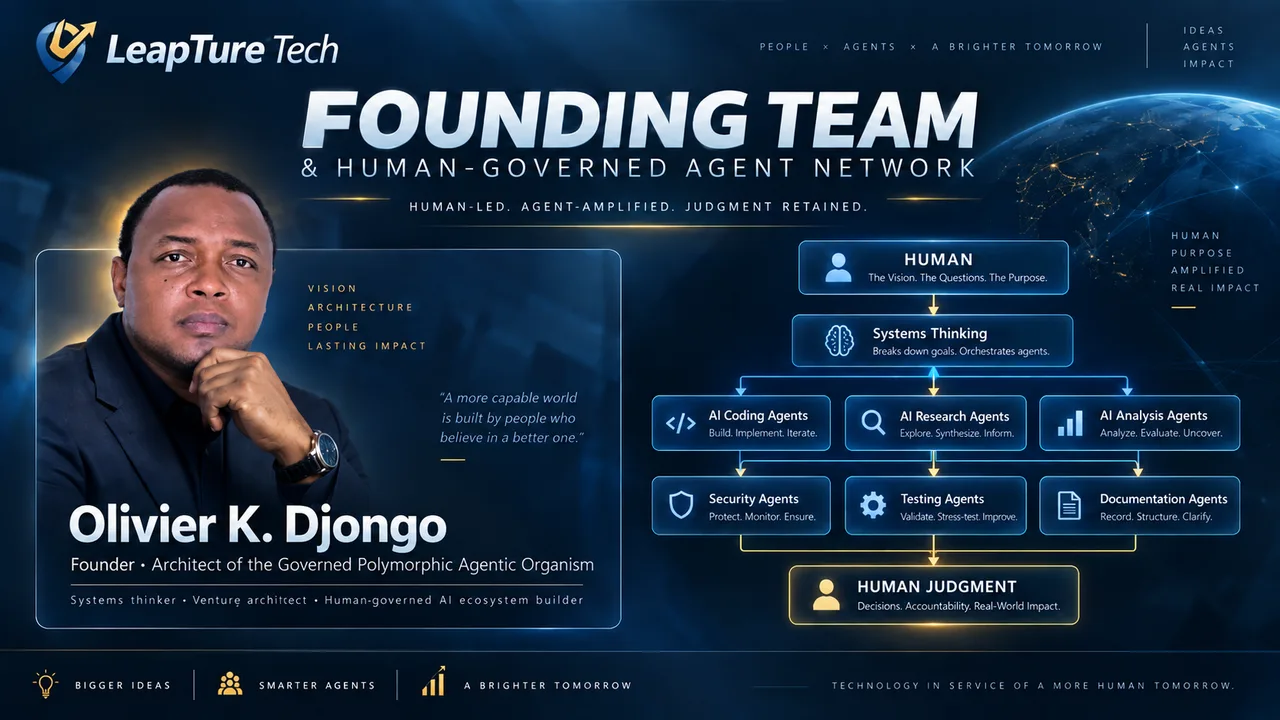
LeapTure founding team visual showing human-led governance and accountable judgment
Public-safe founding-team visual · institutional intent, not a technical blueprint

“The technology changed. The architecture matured. The mission never moved.”

The sustained objective

Digital capability should not be reserved for the already connected.

From the beginning, Olivier K. Djongo's objective was to help people and institutions participate more fully in the digital economy: to democratize meaningful tools, support global small businesses, and help lower-income countries leapfrog constraints that conventional infrastructure too often reproduces.

That objective is not only about productivity. It is also about equitable participation: the ability to act, learn, trade, move, communicate, and create opportunity without being excluded by a device class, language, or conventional digital infrastructure.

“The Rwanda trials disproved the architecture without disproving the mission.”

Evidence across time

A documented pursuit,
not a story written backward.

Each entry records a stage of the journey without collapsing historical concept, prototype, and trial evidence into claims about present production readiness.

2018

Concept & prototype

The mission takes form.

LeapTure concept and prototype process-flow artifacts set out an objective that has remained consistent: democratize meaningful digital capability, help global small businesses participate, and enable lower-income countries to leapfrog.

2019

Early public expression

A public product face appears.

An archived LeapTure customer web experience and advertising video document an early public and product expression of the work. They are historical artifacts, not a statement of current product availability.

2021

Structured development

The pursuit becomes more deliberate.

Project-development materials gave the work a more structured frame: an enduring human objective first, with technology in service of that objective.

2022

Rwanda field trials

The architecture is tested by reality.

Dated field material and merchant-onboarding evidence documented real conditions. The trials revealed that the architecture available then was too costly, vendor-dependent, and fragmented for responsible commercial scale.

Present

A different technical moment

The mission meets a more suitable foundation.

Governed agentic orchestration, bounded authority, domain-owned truth, mediated interfaces, recoverable workflows, and cross-interface continuity now make a materially different architecture possible to pursue.
Field-earned judgment

What the Rwanda trials made unavoidable.

The trial period is not presented as a finished commercial system or a customer endorsement. It is presented for what it contributed: evidence, restraint, and a clearer standard for the work that followed.

01

The mission had to survive the implementation.

The field work did not produce a shortcut to scale. It made clear that responsible access cannot rest on an approach whose economics, dependency profile, and continuity break under real conditions.

02

A pause can be an act of discipline.

The founder paused scaling the architecture, not the mission. That distinction matters: the responsibility was to learn from the evidence rather than force a premature commercial conclusion.

03

The next architecture must earn its claims.

Present work is framed as a designed foundation. External readiness, deployment, and domain-specific capability remain bounded by the evidence that can responsibly support them.

Access is a design responsibility

Human-led.
Agent-amplified.
Judgment retained.

LeapTure is being designed so that participation does not depend on one privileged interface. Its access pattern spans voice, text, smartphones, and feature phones or USSD, with 200+ languages as an intended scope. Availability remains subject to evidence, context, and governed deployment.

Access

More ways to enter

People should be able to approach a service through the interface that is available and appropriate to their situation, without losing the intent of the interaction.

Participation

More ways to benefit

Inclusion means more than using a tool. It means having a credible path to work, trade, learning, mobility, and economic participation.

Authority

More reason to trust

Expanded access does not remove boundaries. Human purpose, explicit authority, and accountable judgment remain central to consequential action.

The present confluence

Enduring mission.
Materially different conditions.

LeapTure now sits where three conditions meet: an enduring public objective, a technical landscape that can support more coherent governed coordination, and judgment earned by learning where earlier approaches did not hold.

That is why this is not a startup origin story written backward. It is a documented pursuit begun before the present AI wave—now being pursued with a clearer architectural standard and a disciplined relationship to evidence.

Claim boundary

Historical artifacts demonstrate continuity of intent. They do not create present deployment, certification, commercial, or regulated-approval claims.

Continue with the institution

Explore the principles behind
the work that follows.

Why LeapTure Company & founder